Serving patients across Kovan, Hougang, Serangoon, Punggol, and surrounding areas of north-east Singapore.
✓ CHAS Accepted
✓ Evening & Weekend Hours
✓ SDC-Registered Dentist
A dental implant is a small titanium post placed into the jawbone to support a replacement tooth. It works by fusing with the surrounding bone — a process called osseointegration — and then carrying a custom-made dental crown on top. For suitable candidates with sufficient bone and good general health, implants can restore the appearance and function of a missing tooth and are maintained much like natural teeth.
Key Takeaways
- Dental implants replace a missing tooth root with a titanium post and a visible crown.
- Suitability depends on bone volume, general health, and oral hygiene — assessed at consultation.
- CBCT scanning at Maple Dental allows precise 3D bone assessment before any procedure.
- Treatment typically spans several months to allow the bone to integrate with the implant.
- Common alternatives include dental bridges and removable dentures; your dentist can explain trade-offs.
- Risks include infection, implant non-integration, and (rarely) nerve or sinus involvement.
- Long-term success requires consistent oral hygiene and regular dental check-ups.
What Is a Dental Implant?
A dental implant is a three-part tooth-replacement system. The first component is the implant fixture — a small screw-shaped post made from biocompatible titanium, placed into the jawbone where a tooth root used to be. Once the bone grows around and bonds to this post (osseointegration), a connector piece called an abutment is attached. Finally, a custom-fabricated dental crown — shaped and shaded to match your surrounding teeth — is secured on top.
The result is a replacement tooth that sits stably within the jaw and allows normal biting and chewing function. Unlike removable dentures, an implant-supported crown does not shift in the mouth. Unlike a dental bridge, it does not require the adjacent healthy teeth to be trimmed.
When Might an Implant Be Considered?
Dental implants are typically considered when one or more teeth are missing — whether due to extraction, decay, injury, or gum disease — and where there is adequate bone structure to support the implant. A single implant can replace one tooth; multiple implants can support several crowns, a fixed bridge, or an implant-retained denture.
Am I a Suitable Candidate?
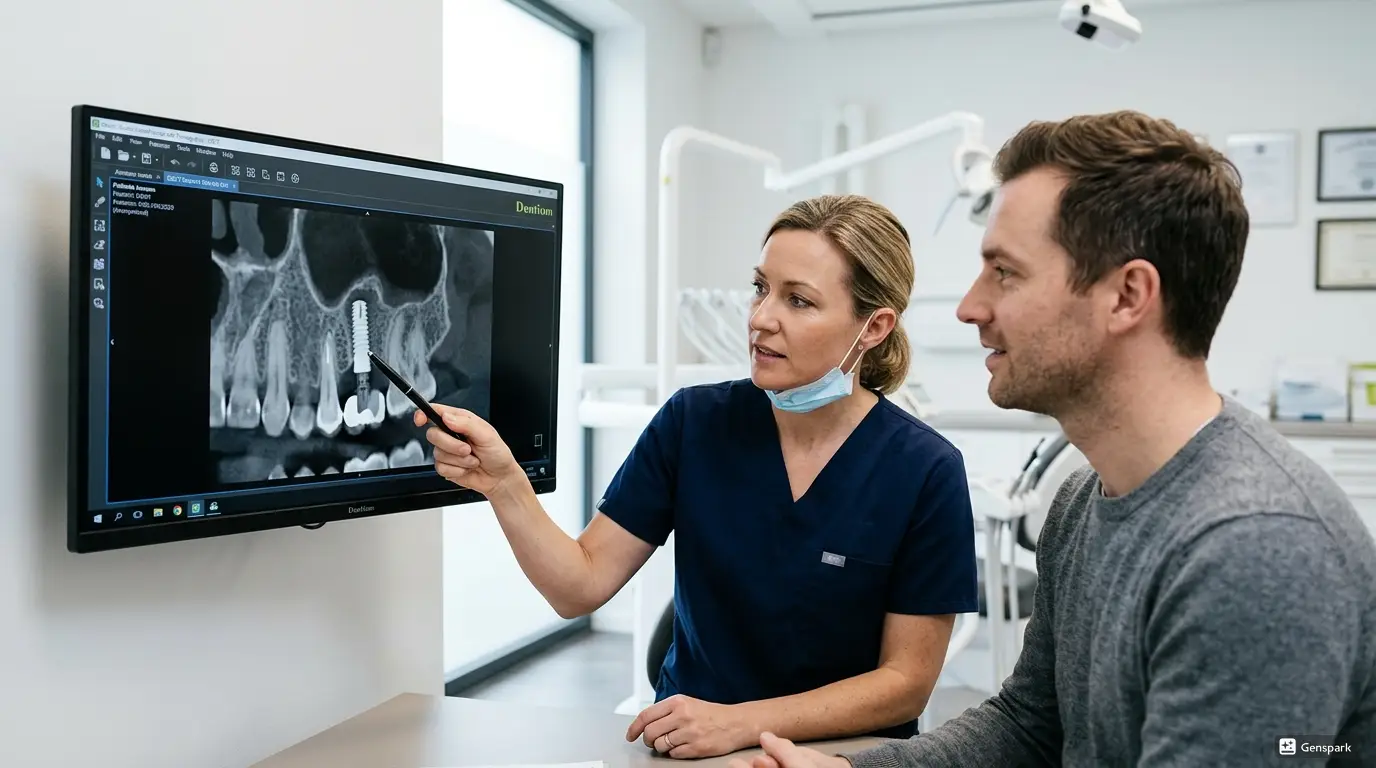
Suitability for dental implants is assessed individually. There is no single checklist that applies to every patient. At Maple Dental, the assessment includes a clinical examination and, where indicated, a CBCT (cone beam computed tomography) scan to evaluate three-dimensional bone volume and quality before any treatment recommendation is made.
May be suitable if you…
- Have one or more missing teeth
- Have adequate jawbone volume, or are a candidate for bone grafting
- Are in reasonably good general health
- Have healthy gums, or have had gum disease treated and stabilised
- Do not smoke, or are willing to stop smoking during healing
- Are committed to regular oral hygiene and dental check-ups
- Are an adult with a fully developed jaw
May not be suitable if you…
- Have insufficient bone (grafting may be discussed first)
- Have uncontrolled diabetes or other systemic conditions
- Are a heavy smoker (higher risk of failure and complications)
- Are undergoing or have recently completed jaw radiotherapy
- Are on bisphosphonate medications (MRONJ risk)
- Have active, untreated gum disease
- Are under 18 (jaw still developing)
- Are pregnant (elective surgery generally deferred)
The Implant Process at Maple Dental (Kovan)
Implant treatment is not a single appointment. It typically takes place over several months to allow proper healing at each stage. The sequence below is a general guide; your individual plan may differ.
- Initial consultation and 3D imaging
Your dentist assesses your teeth, gums, and bite, reviews your medical history, and — where appropriate — takes a CBCT scan to evaluate bone in three dimensions. This allows accurate planning of implant size, position, and angle before any procedure begins. - Treatment planning
Your dentist discusses whether you are a suitable candidate, outlines the procedure, explains alternatives, and provides a written cost estimate. Any preparatory procedures needed are discussed at this stage. - Preparatory procedures (if needed)
Some patients require tooth extraction, bone grafting, or gum treatment before implant placement. These are carried out and allowed to heal first. - Implant placement surgery
The titanium implant is placed into the jawbone under local anaesthesia. You will be awake but the treatment area will be numbed. Most patients return to normal daily activities within a day or two, though some swelling and discomfort in the first few days is expected. - Osseointegration (healing phase)
Over the following weeks to months, the surrounding bone gradually fuses with the implant. This phase typically takes 3 to 6 months depending on bone density and general health. Temporary restorations may be provided during this period. - Abutment and crown placement
Once the implant has integrated, the abutment is attached and an impression or scan is taken to fabricate the final crown. The crown is then fitted and adjusted for comfort and bite. - Review and long-term maintenance
Regular check-ups allow your dentist to monitor the implant, surrounding bone, and gum health. Consistent oral hygiene at home is essential for long-term implant maintenance.
What Implants Can and Cannot Do
Potential advantages compared with other options
Implants are designed to function as a stable, fixed tooth replacement. Unlike a removable denture, they do not need to be taken out for cleaning or secured with adhesive. Unlike a conventional bridge, the teeth on either side of the gap do not need to be prepared (trimmed down) to support the restoration.
When a tooth is lost, the underlying bone can gradually reduce in volume over time. A dental implant transmits biting forces into the jaw in a way that may help reduce this bone loss — though this is not universal and depends on individual factors.
Important limitations
- Implants require adequate bone. If bone has been lost, grafting may be needed first, adding time and cost.
- The full process takes months, not days. Patients needing a quick replacement should discuss temporary options.
- Implants are not suitable for everyone — health conditions, medications, and smoking affect both suitability and outcomes.
- Like natural teeth, implants need consistent oral hygiene. Peri-implantitis — a gum and bone infection around the implant — can develop if hygiene is poor.
- Cost is a consideration. Implant treatment is generally more expensive upfront than bridge or denture options.
Risks and Possible Complications
As with any surgical procedure, dental implants carry potential risks. Your dentist will discuss these in detail before you consent to treatment.
- Infection — at the implant site during or after healing
- Implant failure — the implant does not integrate with the bone; may require removal
- Peri-implantitis — inflammation and bone loss around a functioning implant, often linked to poor oral hygiene
- Nerve involvement — in the lower jaw, the inferior alveolar nerve runs through the bone; careful planning (including CBCT) minimises risk
- Sinus involvement — in the upper jaw, implants placed near the maxillary sinus may require a sinus lift; complications can include sinus infection
- Damage to adjacent teeth or structures — rare with careful planning
- Prolonged healing — more common in smokers, uncontrolled diabetics, or patients with compromised bone
Alternatives to Dental Implants
Dental implants are one option for managing missing teeth — not the only one. Your dentist can explain which options are clinically appropriate for your situation.
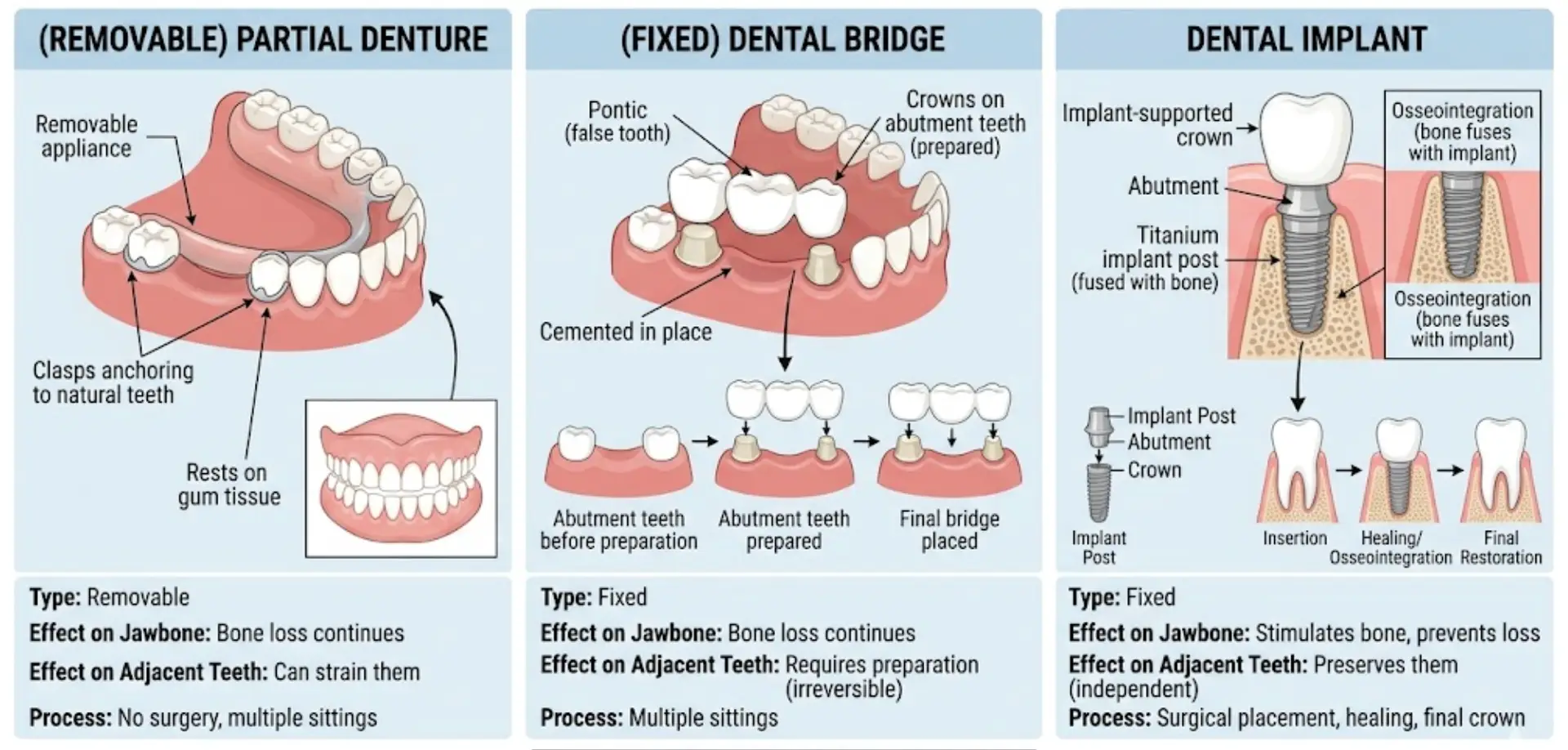
- Dental bridge — A fixed prosthesis spanning a gap by crowning the adjacent teeth. No surgery required. Generally completed more quickly and at lower upfront cost than an implant. The adjacent teeth must be permanently trimmed to support the bridge.
- Removable partial denture — A removable plate carrying one or more replacement teeth. Less invasive and generally lower cost. May feel less stable than fixed options for some patients.
- Implant-supported denture or bridge — Multiple implants supporting a larger restoration. Sometimes referred to as “All-on-4” concepts. May be discussed for patients with many missing teeth.
- No immediate treatment — Monitoring without replacement may occasionally be appropriate, but leaving a gap can allow adjacent teeth to drift and bone to reduce over time.
Recovery and Aftercare
Immediately after implant placement surgery
Some swelling, bruising, and mild discomfort around the surgical site is expected in the first few days. Your dentist will provide post-operative instructions and may prescribe pain relief or antibiotics as appropriate.
- Eat soft foods for the first few days; avoid biting directly on the implant site
- Avoid rinsing or spitting forcefully on the day of surgery
- Avoid smoking during the healing period — smoking significantly increases infection and implant failure risk
- Avoid strenuous physical activity for 48–72 hours
- Attend all scheduled follow-up appointments
Long-term maintenance
Implants require the same daily care as natural teeth — brushing twice daily, cleaning between teeth using floss or interdental brushes, and attending regular dental check-ups. Your dentist may recommend specific tools (such as a water flosser or implant-compatible interdental brushes) to clean effectively around the implant.
Routine professional scaling and polishing allows your dentist to monitor gum health around the implant and address any early signs of peri-implant inflammation before they progress.
Cost of Dental Implants in Singapore
Implant costs vary depending on the number of implants, whether preparatory procedures such as bone grafting or sinus lift are required, the type of crown used, and the clinical complexity of your case.
At Maple Dental (Kovan), the estimated cost for a single implant (including the implant fixture, abutment, and crown) starts from approximately S$850 (after Medisave deduction) . A full cost breakdown is provided in writing following your consultation and 3D imaging assessment.
CHAS and MediSave
Maple Dental accepts CHAS (Community Health Assist Scheme), which provides subsidies on a range of basic dental treatments for eligible Singapore residents. Standard dental implants are currently classified as an elective restorative procedure and are generally not subsidised under CHAS. Please check the CHAS website for the current list of subsidised dental procedures.

MediSave use for dental procedures is governed by MOH withdrawal limits. Certain oral surgical procedures may qualify — your dentist can advise whether any component of your treatment plan is eligible. Dental crowns are not claimable under MediSave.
Treatment Summary
| Patient concern | What it may mean | Possible dental approach | When to book |
|---|---|---|---|
| Single missing tooth | Gap from extraction, decay, or injury | Single dental implant + crown, or dental bridge | Once healing from extraction is complete (usually 2–3 months) |
| Multiple missing teeth | Several gaps or failing teeth | Multiple implants, implant-supported bridge, or implant-retained denture | At consultation — complex cases need detailed planning |
| Loose or ill-fitting denture | Bone loss or poor denture retention | Implant-retained denture (2–4 implants for stability) | At any point — CBCT scan will assess remaining bone |
| Bone loss or swelling around an existing implant | Possible peri-implantitis | Periodontal assessment, professional cleaning, possible treatment | Promptly — do not delay if gum swelling or bleeding is present |
| Wanting to avoid trimming healthy adjacent teeth | Preference not to have a bridge | Single implant and crown | At consultation — discuss suitability and timing |
Singapore Patient Considerations
Location and access
Maple Dental is located at 204 Hougang Street 21 #01-99, Singapore 530204. The clinic is accessible from Kovan MRT station (North East Line) and serves patients from Hougang, Serangoon, Punggol, Sengkang, Tampines, and central Singapore.
Appointment timing
Maple Dental offers evening appointments on weekdays, which is convenient for working adults who cannot attend during standard daytime hours.
- Monday – Friday: 9am – 9pm
- Saturday & Sunday: 9am – 5pm
- Public Holidays: Closed
Call 6288 4995 or WhatsApp 9131 0330 to check availability.
Subsidies and payment
CHAS is accepted at Maple Dental for eligible dental procedures. Patients should bring their CHAS card to the appointment. As noted above, dental implants are not on the current CHAS subsidised list, though other associated treatments may qualify. All patients receive a written cost estimate before treatment begins.
Emergency or urgent dental concerns
If you experience severe pain, swelling, or any concern after an implant procedure, contact Maple Dental directly on 6288 4995. For out-of-hours dental emergencies, you may also contact the National Dental Centre Singapore (NDCS) or Alexandra Hospital’s emergency department. In the event of throat or airway swelling, call 995 immediately.
Common Patient Questions
How long does the dental implant process take?
The full process typically takes between four months and over a year, depending on whether preparatory procedures such as bone grafting are required and how quickly your bone heals. The surgical placement itself is a single clinic appointment; the osseointegration phase usually takes 3 to 6 months before the final crown is fitted.
Is the implant placement procedure painful?
The placement is carried out under local anaesthesia, so you should not feel pain during the procedure. After the anaesthetic wears off, some soreness, swelling, and mild discomfort for a few days is normal. Your dentist will advise on pain management. Experiences vary between individuals.
How long do dental implants last?
Published clinical studies report high implant survival rates over 10-year follow-up periods in suitable patients who maintain good oral hygiene and attend regular check-ups. However, no implant can be guaranteed to last indefinitely. The crown may need replacing after many years due to normal wear. Long-term outcomes depend on bone quality, general health, oral hygiene, and other individual factors.
Can I get a dental implant if I have had bone loss?
Bone loss does not automatically rule out implants, but it needs careful assessment. A CBCT scan lets your dentist measure available bone in 3D. If bone volume is insufficient, procedures such as bone grafting or a sinus lift may be recommended as preparatory steps. Not all patients will be suitable even after grafting — your dentist will advise honestly based on your scan.
Can smokers get dental implants?
Smoking is a recognised risk factor for implant failure, peri-implantitis, and slower healing. It does not automatically disqualify a patient, but your dentist will discuss the increased risks with you. Most implant protocols strongly recommend stopping smoking during the healing phase at minimum, and ideally long-term.
Is a dental implant better than a bridge?
Neither option is universally better — they involve different trade-offs. A bridge is completed more quickly, does not require surgery, and is generally less expensive upfront, but requires the adjacent healthy teeth to be permanently trimmed. An implant does not affect adjacent teeth, but requires sufficient bone, takes longer, and involves surgery. The right choice depends on your oral health, bone volume, budget, and preferences.
Does CHAS cover dental implants in Singapore?
Standard dental implants are not currently on the CHAS list of subsidised procedures, as they are classified as an elective restorative treatment. CHAS subsidies apply to basic dental services such as scaling and polishing, fillings, and extractions. Check chas.sg for the current list.
What is CBCT and why is it used for implant planning?
CBCT (cone beam computed tomography) produces a three-dimensional image of your jaw and surrounding structures. Unlike a standard dental X-ray, it lets your dentist see the exact height, width, and density of bone, and the precise location of nerves and sinuses — allowing more accurate implant planning. At Maple Dental, CBCT imaging is available in-clinic and used where clinically indicated.
What happens if a dental implant fails?
If an implant does not integrate with the bone or becomes infected and mobile, it is usually removed, the site is allowed to heal, and in some cases a new implant can be attempted after a waiting period. Not every failed implant site can be re-implanted. Your dentist will assess and advise based on your circumstances.
Are dental implants safe for patients on blood thinners or with diabetes?
Patients on anticoagulant medications or with diabetes can sometimes undergo implant procedures, but require careful assessment and coordination with their medical team. Uncontrolled diabetes significantly increases the risk of infection and poor healing. Your dentist will review your medications and medical history at consultation and, where appropriate, may liaise with your physician before proceeding.
This information is general in nature and does not replace an individual dental consultation. The suitability of dental implants varies between patients and must be assessed by a registered dentist based on your clinical and medical history. Treatment outcomes cannot be guaranteed. Always seek professional dental advice before proceeding with any dental treatment.
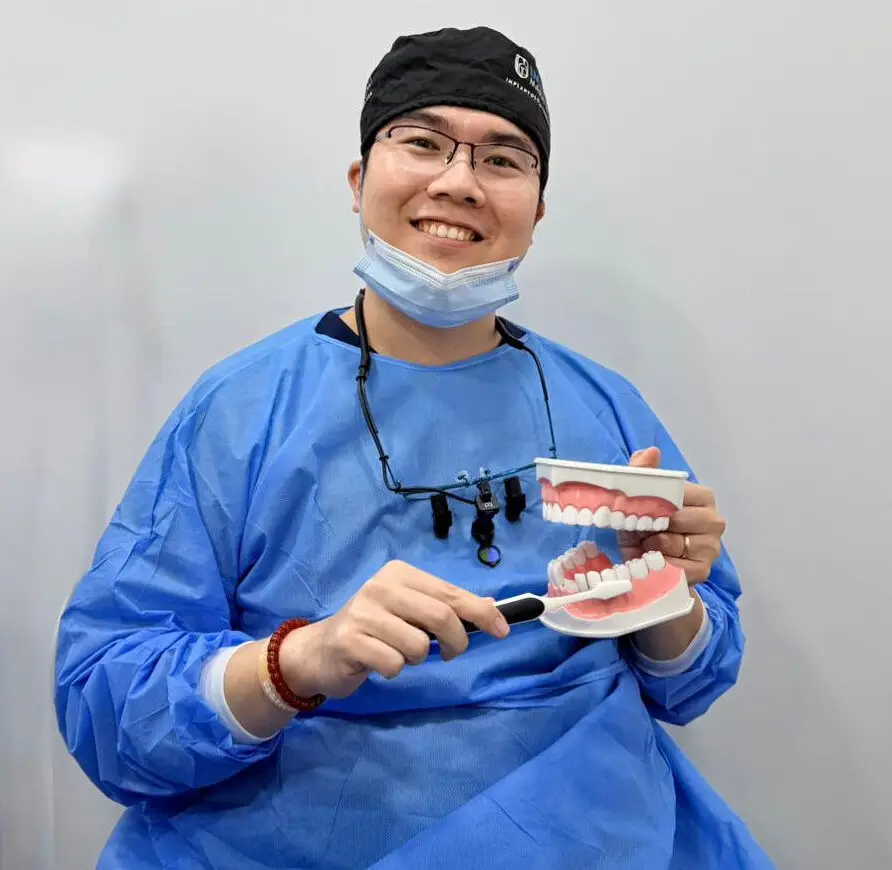
Dental Surgeon, Maple Dental (Kovan) · Last reviewed: May 2026
Dr Lam holds a Bachelor of Dental Surgery from the National University of Singapore and practises general dentistry including implant assessment and placement at Maple Dental (Kovan), Singapore.
Considering a Dental Implant?
Start with a Consultation.
A proper assessment — including a 3D CBCT scan where needed — is the first step to understanding whether an implant is suitable for you. Maple Dental offers evening and weekend appointments in Kovan, north-east Singapore.
204 Hougang Street 21 #01-99, Singapore 530204
Tel: 6288 4995 | WhatsApp: 9131 0330